

The Supplicant
Two months after Operation Epic Fury, Trump traded long-term strategic assets for short-term relief in Beijing — on a calendar Beijing now controls.

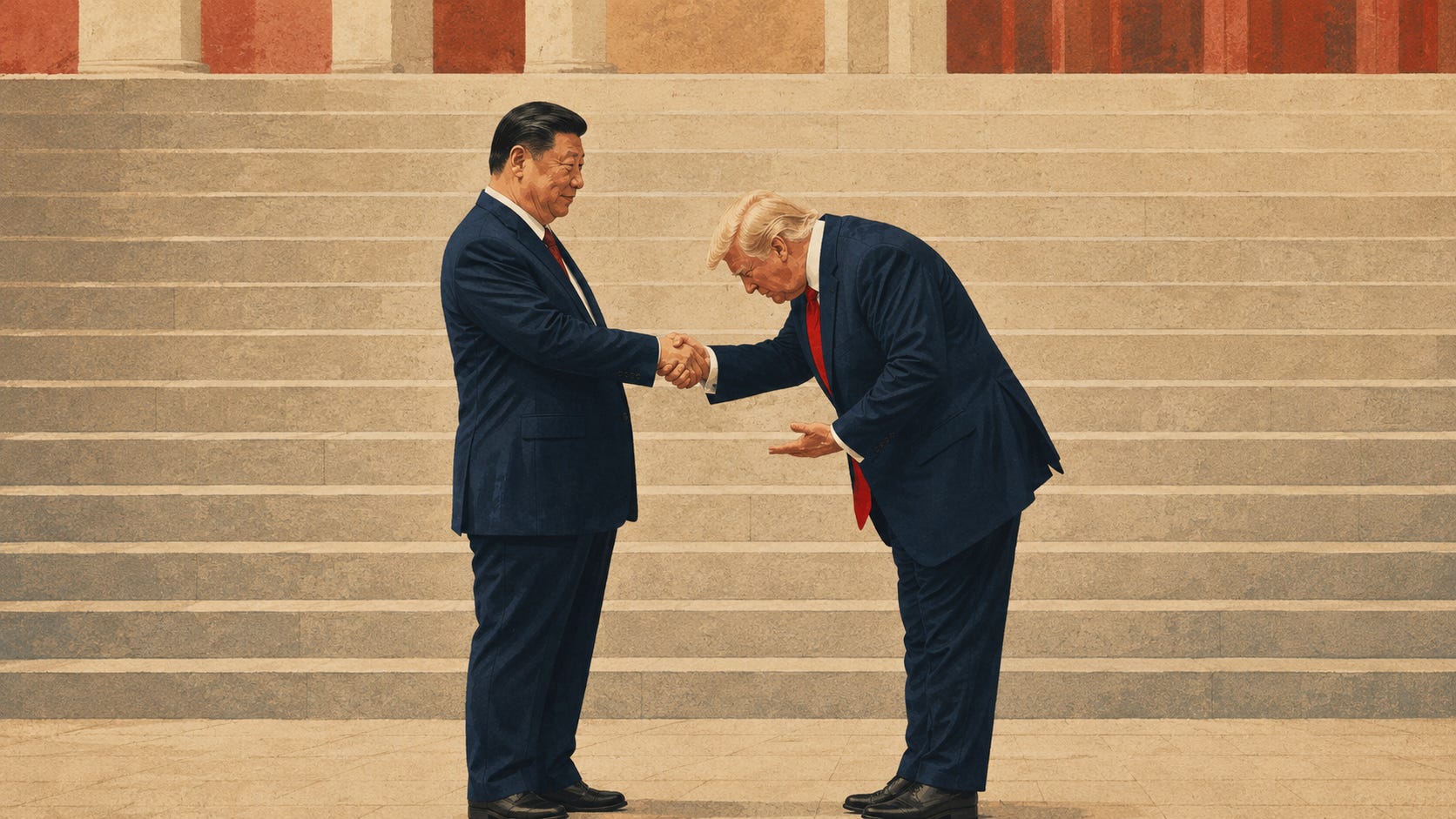
Everything about Donald Trump’s reception in Beijing had been prepared. A 21-gun salute at Tiananmen Square. Hundreds of children waving bouquets. A state banquet inside the Great Hall of the People, with a small model of the Temple of Heaven at the center of the table. An afternoon tour of the imperial complex itself, where Ming and Qing emperors had once prayed for good harvests.
Less visible but no less choreographed were the words Trump and Xi Jinping exchanged. During state visits of this magnitude, every noun, every verb, every shift in tense is chosen before the leaders sit down. It was therefore notable that in opening remarks welcoming Trump to Beijing, Xi posed a seemingly innocuous but in reality stinging question: “Can China and the United States overcome the Thucydides Trap and create a new paradigm of major-country relations?”
Xi had used the phrase before. With Barack Obama in 2013, with audiences in Seattle and Davos. Until this week he had framed the trap as a hypothetical problem requiring “repeated strategic miscalculations” by major powers. This time, the Financial Times observed, he seemed to suggest it was a pressing danger. Xi was also assigning roles: China as Athens, America as Sparta. The grammar changed.
There was good cause for him to reframe. The New Record argued in March, on the framework Charles Hill spent decades teaching at Yale, that the American war on Iran would exhaust the capacity needed for the strategic contest with China. The May 14-15 summit was the first concrete measurement. The exhaustion now registers in posture, in dependency and in the asymmetry of what Trump was prepared to trade.
The Optics Were the Substance
Trump came to Beijing with requests: pressure on Iran to reopen the Strait of Hormuz, Chinese purchases of soybeans and Boeing aircraft, commitments on rare earths and advanced chips. Xi came offering language: “mutual respect,” “constructive relationship of strategic stability,” “partners not rivals.”
“In terms of optics and rhetoric, Xi probably came across as stronger,” Ja Ian Chong of the National University of Singapore told the FT. “Trump looked like he was pleading, needing something from Xi, with all of the unrequited praise.”
The praise was elaborate. “You are a great leader,” Trump told Xi in remarks People’s Daily found worth reprinting. “Everyone in the United States is talking about my visit. I feel very honored to be here.”
Chinese state media translated the praise into Mandarin with care. State outlets had Trump address Xi using 您, the formal and respectful form of the second-person pronoun. Xi addressed his American guest with 你, the common form. The asymmetry is hardwired into the language. A reader who does not speak Mandarin can grasp it instantly: the visitor had been rendered as supplicant.
Trump came home repeating Beijing’s framing. Asked on Air Force One about Taiwan, he produced statements that David Sacks of the Council on Foreign Relations read as evidence Xi’s presentation had “an effect on Trump.” On Taiwan independence: “Well, it’s a risky thing when you go independent... They’re going independent because they want to get into a war.” On the $14 billion arms package Taiwan has been waiting months to receive: “It depends on China... It’s a very good negotiating chip for us, frankly.”
Orville Schell of the Asia Society offered a measured read: the trip was “transactional and some might even say synthetic, but it did work its magic in a certain sense.” The strongest defense is that Trump bought time. The tariff truce held. Rare-earth flows improved at the margins. No formal Taiwan concession.
For a president managing oil prices, bond yields and midterm politics after an expensive Middle East war, temporary relief is not nothing. Whether the time was bought or merely scheduled is the question. Where Beijing once traded concession for concession, “now,” Andrew Gilholm of Control Risks told the FT, “China handles the US more by deterrence than concessions.”
The Exhausted Negotiator
The supplication was a function of the baggage Trump carried into the room. On the Tuesday before his arrival, the Treasury auctioned $25 billion of 30-year bonds at 5.046%. It was the first long-bond auction above 5% since 2007. By the day his plane left Beijing, the yield had climbed another 11 basis points to 5.121%, the highest since May 2025. “Debts and deficits matter,” Peter Boockvar of One Point BFG told CNBC. “Long-end rates are now in control of monetary policy.”
Those rates were a verdict on the fiscal picture behind them. On May 13, gross federal debt stood at $38.97 trillion. From October through April, net interest paid by the Treasury reached $628 billion, exceeding outlays on Medicare, Medicaid and defense. The fiscal year-to-date deficit hit $955 billion. The Pentagon’s $200 billion supplemental request for the Iran war remains stalled in Congress.
The fiscal pressure has a strategic counterpart. Stephen Walt, who spent a career arguing fears of Chinese regional hegemony were overstated, is revising his stance. “Trump is the fourth U.S. president who took office vowing to focus on China’s rising power in Asia,” Walt wrote in Foreign Policy on May 12, “and like all his predecessors, he ended up in a quagmire in the Middle East instead.”
The Iran war has consumed munitions the United States will need Beijing’s help to rebuild. The Center for Strategic and International Studies, in analysis cited by Bloomberg, found that the United States may have drawn down more than half its prewar stockpile of key munitions. Heavy rare earths required to replace those systems are controlled almost entirely by China.
What Became Negotiable
Trump’s biggest concession to Beijing was something he didn’t give: the $14 billion arms package Taiwan has been waiting months to receive. The package includes PAC-3 interceptors, anti-drone systems and air-defense radars. It is the deterrent for Taiwan, whose foundries produced 69.9% of the world’s chips in 2025 and 90% of the most advanced ones.
Those advanced chips anchor a global AI economy McKinsey projects at $5.2 trillion in cumulative capital expenditure through 2030. “It looks increasingly likely that Trump will indefinitely withhold the $14 billion arms package to Taiwan,” Amanda Hsiao of Eurasia Group told the New York Times, “in the hopes that Beijing will give him what he wants on the economic front.” The arms package hasn’t been canceled. In deterrence, that distinction is smaller than it sounds: withheld capability functions as a signal.
What Beijing offered in return was thinner than it looked. The Boeing 200-plane “commitment” Trump announced from Air Force One produced no aircraft type, no delivery timeline, no customer allocation. IBA Group put the total at $17 billion to $19 billion at list, far below the 500-aircraft figure analysts had expected was under discussion. Boeing’s stock fell 4.7% on the day and another 3.8% the day after.
The soybean baseline reaffirmed at Busan implies roughly $10 billion in annual Chinese purchases, below 2017’s $12.3 billion pre-trade-war figure. Nvidia’s H200 framework for ten approved Chinese buyers has produced not a single shipped chip.
The chip industry is one of two American supply chains where the strategic stakes meet the dependency calendar. The other is rare earths. Bloomberg Economics estimated this week that the industries dependent on them constitute about 4% of US GDP, or roughly $1.2 trillion. Rare earths from China are improving, US Trade Representative Jamieson Greer told Bloomberg Television, but there are still times “when exports are slow and we have to go and make our point.”
McKinsey, CRU Group and Benchmark Mineral Intelligence converge on the same projection: countries outside China will meet less than 20% of demand for dysprosium and terbium, the heavy rare earths that go into the magnets of military jet motors and electric vehicle drivetrains, by 2035. The trade truce that cut tariffs from 145% to 30% expires November 10, and so does the rare-earth suspension. The American midterms are November 3, a week earlier.
The dependency remains. Beijing’s interest is in keeping relief temporary enough that Trump must come back when the political cost of failure is highest.
The Calendar Beijing Set
Hill argued for decades that the Sicilian Expedition was the archetype of great power decline. Athens had the military capacity to reach Sicily. What it didn’t have was a strategically coherent reason to be there and the discipline to abandon the venture before it consumed the resources reserved for the contest with Sparta. The decline showed first in the asymmetry of what Athens was prepared to trade — its ships, its treasure, its allies’ confidence — for an objective whose value never matched the cost. After Sicily, Persia bankrolled the Spartan fleet that Athens could no longer match.
Whether Trump framed the visit in these terms is unknowable and beside the point. The outcome is observable. China kept moving as he negotiated.
Its GDP grew 5% in the first quarter, with growth concentrated in the export sector. March solar exports doubled to 68 gigawatts. Electric vehicle exports rose 77.5%. Of those, the United States now takes 11%. Three deadlines now fall in early November: the trade truce, the rare-earth suspension, the American midterms.
The trade Trump made in Beijing was a long-term asset for short-term relief. He arrived diminished by a war whose residue runs through Chinese-controlled magnets. He left having signaled that Taiwan’s defenses, and the foundries that anchor America’s AI infrastructure, could be treated as leverage. The bill for America’s wrong fight is being paid in what Washington must trade to manage the fallout. The calendar for those trades is now set in Beijing.