

Athens Went to Sicily. America Went to Iran
Donald Trump is hurtling toward a strategic disaster unparalleled in American history.

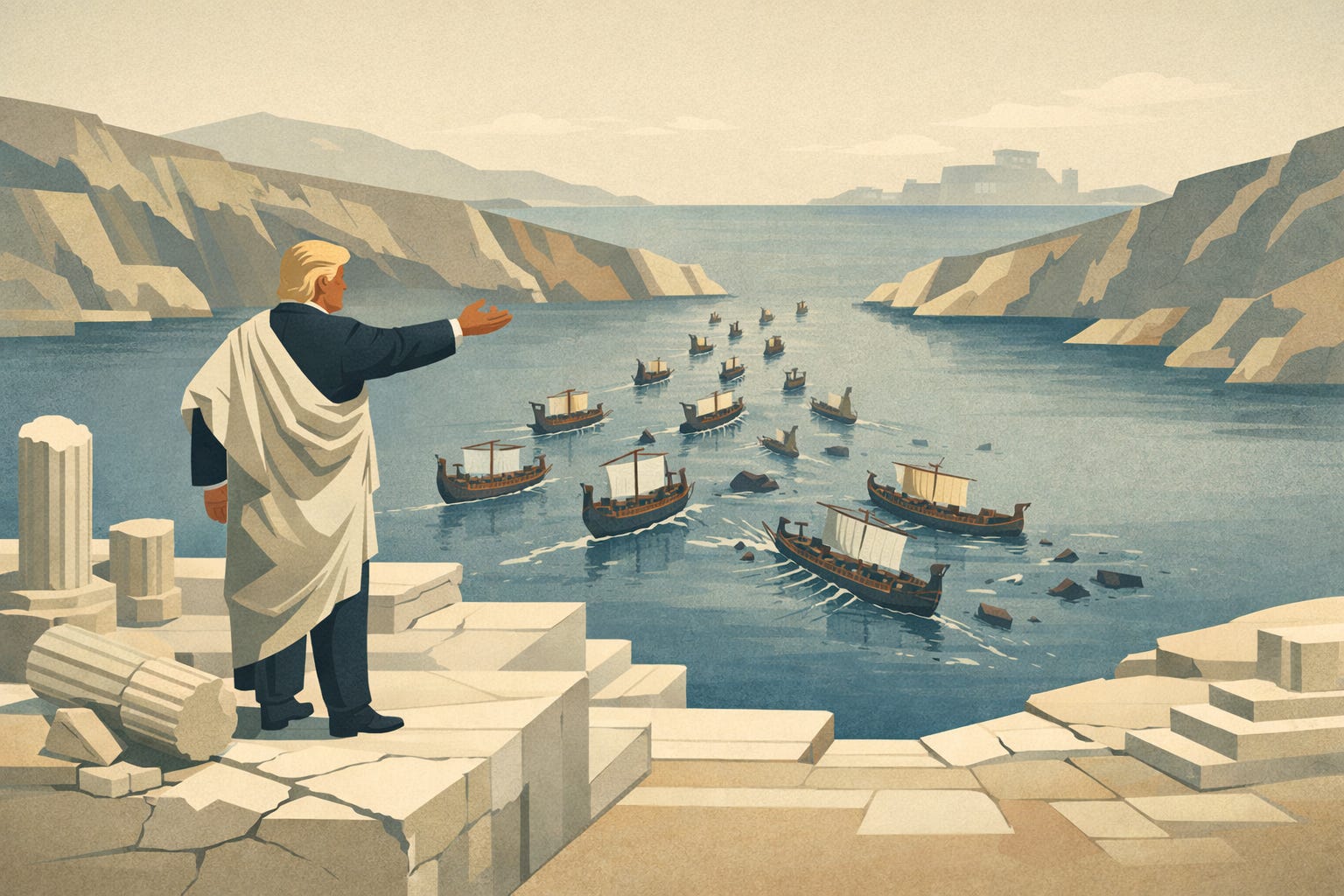
In 415 BC, Athens sent the largest naval expedition in its history to Sicily. The island was far from the war with Sparta that actually threatened the empire’s survival, but a charismatic and reckless Athenian leader named Alcibiades had talked the Assembly into it, having promised glory without a strategy to achieve it. Objectives shifted before the fleet cleared the harbor: conquer Syracuse, punish it, deny it to Sparta, establish a forward base. Command was split between generals who disagreed on the mission’s purpose. Athens had the military power to reach Sicily, but what it lacked was a coherent reason to be there.
Two years later, the expedition was annihilated. Nearly the entire force was killed or enslaved. The losses were so ruinous that Athens never recovered its strategic position. Persia, sensing weakness, funded the Spartan navy for the first time. Allied states revolted. Within a decade, Athens had surrendered. The ships, the treasury, the commanders and the allied confidence destroyed in Sicily were the resources Athens needed for the war with Sparta — the war that would determine whether the empire survived. The Sicilian Expedition was the catalyst for the fall of one of the ancient world’s greatest powers.
Charles Hill, the diplomat who co-founded Yale’s Grand Strategy program and spent decades teaching Thucydides as a diagnostic manual for American statecraft, argued that the Sicilian Expedition was not an anomaly. It was an archetype. Great powers do not decline because they lack military capability. They decline because they commit to the wrong fight at the wrong time, pouring resources into a venture they cannot define and cannot end, while the competition that actually threatens their survival continues without them.
The parallels to the present are not subtle. On February 28, the United States launched Operation Epic Fury against Iran under a leader who sold the venture without defining victory, into a theater far from the competition with China that will determine American primacy for the next century. Objectives shifted within days. Command signals contradicted each other within hours. No coalition was assembled. No congressional vote was held. Three weeks later, the war has no stated endgame, no diplomatic off-ramp and a cost structure that compounds by the day into an economy with no remaining capacity to absorb it.
The War That Cannot End
Hill’s archetype has a specific mechanism: strategic incoherence produces open-ended commitment, and open-ended commitment is what turns a military operation into an economic catastrophe. That mechanism is now operating at speed.
The administration began with regime change, then cycled through unconditional surrender, nuclear disarmament and degrading Iran’s military capacity. These are four different wars. Neither side will negotiate. Trump called ceasefire efforts “too late.” Iran’s foreign minister told CBS his country never asked for one. Ali Larijani, a senior Iranian national security official, warned publicly that ending the war wouldn’t happen with a few tweets. Days later, Israel assassinated him. Robert Kaplan argued in Foreign Affairs this month that this is a middle-sized war: large enough to cause immense destruction, undefined enough to lack a logical stopping point.
The longer it runs, the more it fractures the alliances the United States depends on. Five of the seven G7 nations issued a tepid joint statement this week calling for safe passage through the Strait of Hormuz, but the European Union is demanding a ceasefire first, effectively siding with diplomacy over Washington. China is negotiating transit directly with Tehran. India has secured bilateral passage for its tankers. Washington itself eased sanctions on Russian oil to manage the supply shock, delivering Moscow an estimated $150 million a day in additional revenue while getting little relief on prices.
Each of these developments erodes the architecture that has underwritten American economic leadership since 1945. Hill would have recognized the pattern. Athens didn’t just lose ships in Sicily. It lost the confidence of the allies whose loyalty made the empire viable.
The Economy With No Shock Absorbers
The United States has fought expensive wars before. It has absorbed oil shocks before. In the 1970s, it survived both at the same time. What it has never done is face an open-ended military commitment and a compound supply shock when its balance sheet was already this exhausted.
When a major economic shock hits, a government has two ways to protect its economy. The central bank can cut interest rates to make borrowing cheaper. Or the government can spend its way through the crisis, running larger deficits to absorb the damage. In 1975, 2001, 2008 and 2020, the United States used one or both. Each time, the economy recovered because there was room to act.
Neither option exists today, as the war accelerates the stagflationary conditions that were already building before the first strike. The Federal Reserve held rates on Wednesday and raised its inflation forecast. Powell used the phrase “don’t know” seventeen times in his press conference and acknowledged that the Fed faces a conflict between its two mandates: the oil shock is pushing inflation higher while the labor market weakens beneath it. The Fed is frozen, unsure how to fight inflation without deepening the slowdown, unable to support the economy without accelerating prices.
The fiscal side is worse. The United States carries $38.86 trillion in gross federal debt, equal to 101% of everything the economy produces in a year. The deficit is running at $1.9 trillion annualized, nearly 6% of GDP, before a single dollar of war spending. Interest payments alone now exceed $1 trillion a year, more than the country currently spends on its entire military.
This week, the Pentagon requested $200 billion in additional war funding, a request that will land before a Congress that has not yet authorized the war itself. Before Iraq, debt-to-GDP was 33%. Before Vietnam, roughly 40%. At those levels, the government had room to borrow its way through a crisis. At 101%, that room is gone, and any dramatic increase in wartime spending risks catalyzing a fiscal crisis the country has no tools left to manage.
And the debt isn’t just large, it’s self-reinforcing. When inflation fears push interest rates higher, the government’s borrowing costs rise with them. Higher borrowing costs widen the deficit. A wider deficit forces the Treasury to sell more bonds, which pushes rates higher still. The 30-year Treasury yield sits at 4.85%, just below the 5% level that Bank of America strategist Michael Hartnett has identified as a trigger for forced policy intervention. The war did not create this trap, but every week of open-ended conflict tightens it further.
The evidence of strain is already visible. Brent crude at $108 a barrel, while Goldman Sachs has warned that a prolonged Strait closure could push oil to $150. Urea fertilizer up 40%. Global liquefied natural gas supply cut by a fifth. The IEA has called this the largest supply disruption in its history.
Analysts are increasingly sounding the alarm as the economic consequences of the war metastasize. Moody's Analytics chief economist Mark Zandi puts the probability of a recession within twelve months at 49%, essentially a coin flip, up from roughly 15% before the war began. JPMorgan's global research team has placed the odds at 35% and warned that investors are failing to price the damage, noting that four of the five oil shocks since the 1970s have led to recession.
The Contest That Actually Matters
Athens did not set out to destroy itself in Sicily. It set out to expand its influence, demonstrate its power and seize an opportunity that a charismatic leader made sound irresistible. What it accomplished instead was the exhaustion of the resources it needed for the contest with Sparta — the contest that would determine whether the empire survived. Hill spent a career arguing that this was the pattern which separates great powers that endure from those that destroy themselves: not defeat in battle, but the slow drain of capacity on the wrong fight.
The United States’ defining competition is with China. Beijing is building strategic reserves, positioning itself as a mediator between Iran and the Gulf states and negotiating Hormuz passage on its own terms. Every depleted munition, every fractured alliance, every trillion in new debt service is a resource unavailable for that contest.
Operation Epic Fury threatens to be the most costly strategic decision of any American presidency — not because the strikes failed militarily, but because the war is consuming what remains of the nation’s fiscal and economic resilience at precisely the moment it can least afford to lose it. The United States cannot borrow its way out. The Federal Reserve cannot cut its way out. Its allies are already looking for the exits. And the interest on $38.86 trillion accrues at $7.2 billion a day whether the Strait reopens or not.
The comparison was made for the 2003 Iraq war too. But this attempt is more feckless, less capable, more dangerous, and more broke.
Well done! This piece concisely describes our current situation and needs to be told.