

The Return to the Commanding Heights
The war in Iran is accelerating a global shift that was already underway. Every major power is reclaiming control of strategic physical industries.

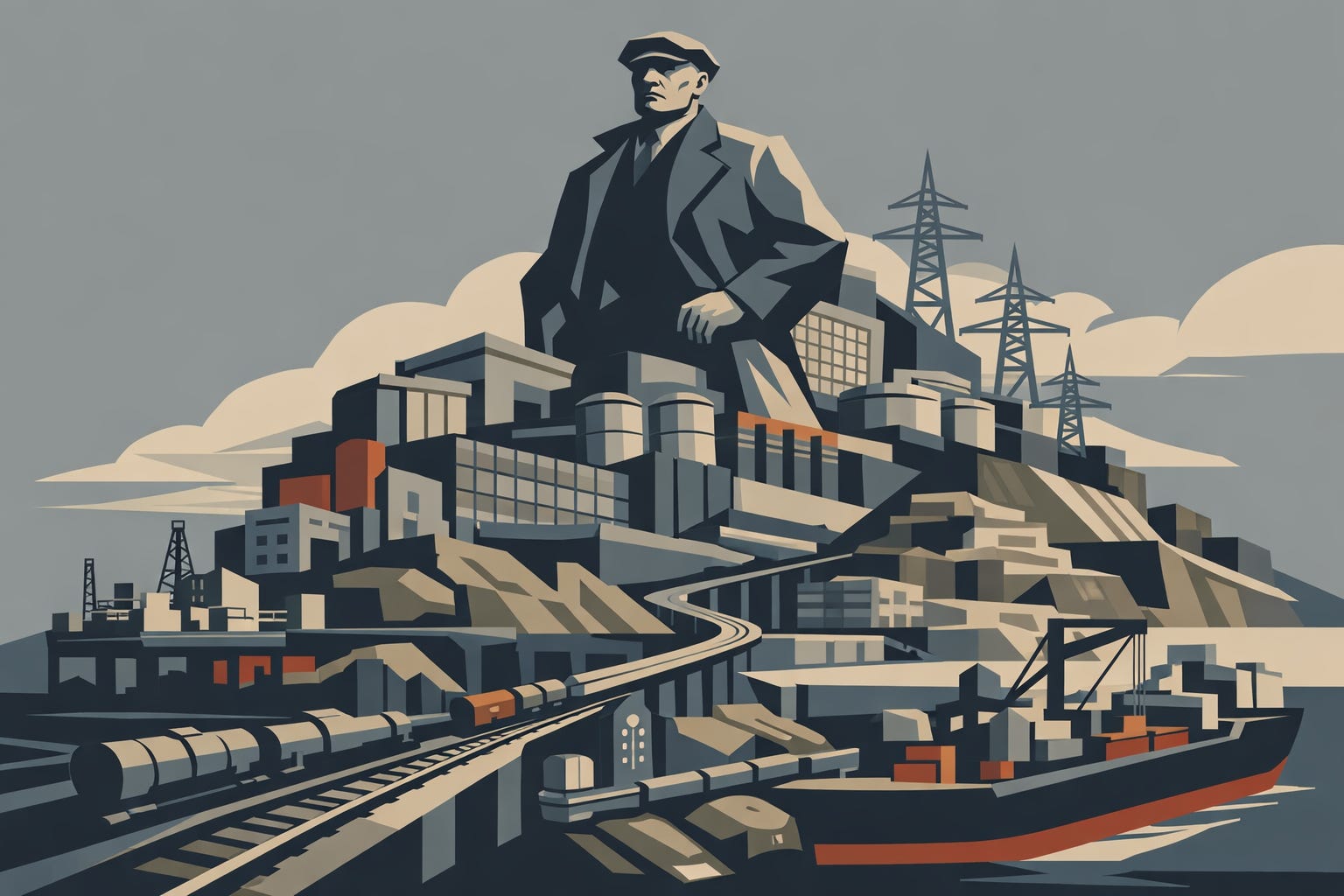
In the spring of 1922, Vladimir Lenin faced a hostile room. The Bolshevik economy collapsed. Industrial output stood at a fraction of its prewar level, and Lenin’s own party was accusing him of betraying the revolution by permitting limited private commerce under the New Economic Policy. His defense drew on a military metaphor.
The state, he argued, did not need to own every bakery and tailor shop. It needed to hold the sectors from which power over the rest of the economy flowed: heavy industry, energy, railroads, banking, foreign trade. Lenin called these the commanding heights. Hold the high ground and you dominate the terrain below.
For the rest of the twentieth century, the phrase marked a fault line in global economics. Who should control the commanding heights: states or markets? By the late 1990s, the answer seemed obvious. Daniel Yergin and Joseph Stanislaw’s 1998 book The Commanding Heights chronicled what appeared to be a permanent settlement. Thatcher had privatized British Telecom and British Gas, Reagan had deregulated the airlines, the Soviet Union had disintegrated, and trillions of dollars in state-owned assets had passed into private hands from Santiago to Singapore.
The service economy would replace manufacturing. Software would eat the world. The best graduates in London and New York fought for places at investment banks and consultancies. China, meanwhile, was producing ten times as many engineers as the United States each year, though few in the West noticed and fewer cared.
The Reclamation
After the United States and Israel began military operations against Iran in late February, Tehran moved to close the Strait of Hormuz to commercial traffic, bringing roughly a fifth of the world’s liquefied natural gas and a quarter of its seaborne oil to a standstill. The disruption exposed a structural vulnerability. The raw materials that the global economy depends on are concentrated in a handful of chokepoints, controlled by a handful of states. Who holds the commanding heights — and what happens when they use that leverage — is no longer an academic question. The shift toward greater state control of strategic physical industries has already been building for five years, and the conflict in Iran promises to force the pace.
Since the pandemic, governments have been steadily reclaiming the commanding heights. Covid-19 revealed that masks, ventilators, semiconductors and pharmaceutical precursors all depended on supply chains no single country controlled and few had bothered to map. The scramble that followed never really ended. It widened.
Russia’s invasion of Ukraine weaponized European energy and forced Germany to nationalize the utility Uniper to keep the lights on. The CHIPS Act and the Inflation Reduction Act marked a broader American acceptance that industrial policy was not a dirty phrase. Governments began intervening in sectors they had spent a generation privatizing, and the interventions kept accumulating.
The scale is now quantifiable. A database called the New Industrial Policy Observatory, maintained by the International Monetary Fund and researchers at the Swiss business school IMD, has catalogued more than 34,000 industrial policy interventions across 75 economies since 2009. Since 2020, the annual rate has nearly doubled, with the United States, the European Union and China together accounting for close to half of all measures. Tariffs have grabbed the headlines, particularly in the United States, but the broader toolkit has shifted toward subsidies, grants and directed procurement, which now account for the majority of new interventions. The question among policymakers is no longer whether governments should pursue industrial policy but how.
The interventions share a direction, if not a playbook. Every major economic power has arrived at the same conclusion independently, for different reasons. In Washington, the Trump administration has taken equity stakes, golden shares and revenue-sharing arrangements in at least a dozen private companies, from a 10% ownership position in Intel to a golden share giving the president veto power over United States Steel. Kevin Hassett, director of the National Economic Council, called the portfolio “a down payment on a sovereign wealth fund.”
In Brussels, the European Union’s ReArm Europe plan aims to mobilize €800 billion in defense spending by 2030, and 17 member states have activated escape clauses in the bloc’s fiscal rules to fund it. Beijing never surrendered the heights in the first place. China controls roughly 90% of global rare earth processing, dominates global shipbuilding and spends an estimated 4% of gross domestic product on industrial subsidies. Japan has committed $25.7 billion to semiconductor production alone.
The rotation was already visible in asset prices before the first missile struck. In February 2026, Goldman Sachs strategists Guillaume Jaisson and Peter Oppenheimer introduced a framework they called HALO: Heavy Assets, Low Obsolescence. Their basket of capital-intensive European stocks, spanning utilities, energy, basic resources and industrials, had outperformed capital-light businesses by 35 percentage points since January 2025. The decade-long valuation gap between the two groups had effectively closed. None of this required a war to begin, but a war ensures it won’t reverse.
Orderly or Not
What separates the Iran shock from its predecessors is pace. The financial crisis and the pandemic each triggered government intervention that was meant to be temporary. Neither fully unwound, and Russia’s invasion of Ukraine added a third round with no end in sight. But the adjustments were gradual enough that governments could treat each intervention as an exception rather than a new rule. The Hormuz disruption offers no such luxury, pressuring states to compress what might have been a five-year structural rotation into months.
The physical costs are rapidly mounting. The Carnegie Endowment for International Peace estimates that about a third of the world’s seaborne fertilizer transits the Strait of Hormuz. With Oman benchmark crude trading near $170 per barrel on the physical spot market while paper futures hover near $100, the Carlyle Group’s Jeff Currie described the gap between the financial economy and the physical one: “You can’t print molecules.” Iran’s parliamentary speaker, Mohammad Bagher Ghalibaf, borrowed the phrase to mock Washington, daring the administration to turn its jawboning into gasoline.
Governments that could have spent a decade rebuilding semiconductor capacity, diversifying energy supplies and restocking critical mineral reserves are instead acting under crisis conditions, without the engineering pipelines or the institutional memory to do it competently. The United States graduates roughly 130,000 engineers a year; China, 1.3 million. That ratio doesn’t change quickly, regardless of how many golden shares a president accumulates.
The return to the commanding heights was coming with or without a war, but the war has redefined the terms. When governments reclaim strategic industries gradually, with planning and investment, the result is industrial policy. When they do it with crude prices at wartime levels and fertilizer shipments stalled in the Persian Gulf, the result is something less controlled and considerably more expensive. Every major economy is now racing to secure the physical foundations of economic power — the energy, the minerals, the chips, the steel. The leverage that was built for the world of weightless capital, for software companies valued at thirty times revenue and private credit portfolios loaded with asset-light borrowers, was not designed for this one.
Lenin argued that whoever held the commanding heights controlled the outcome. A century later, from Washington to Brussels to Beijing, every major power has reached the same conclusion. The scramble to reclaim the high ground is underway. Whether it proceeds as strategy or as disorder depends on what happens next.
Editor’s Note: This is the first installment of “The Return to the Commanding Heights,” a series on the global shift from capital-light to capital-intensive economic models. Part II examines the market rotation and the industrial policy surge in detail. Part III traces the credit exposure sitting on the wrong side of the shift.
Always interesting.