

The Eccles Inheritance
Kevin Warsh takes the Federal Reserve chair on Friday. None of his options on interest rates spares lower-income Americans from the cost of the Iran war.

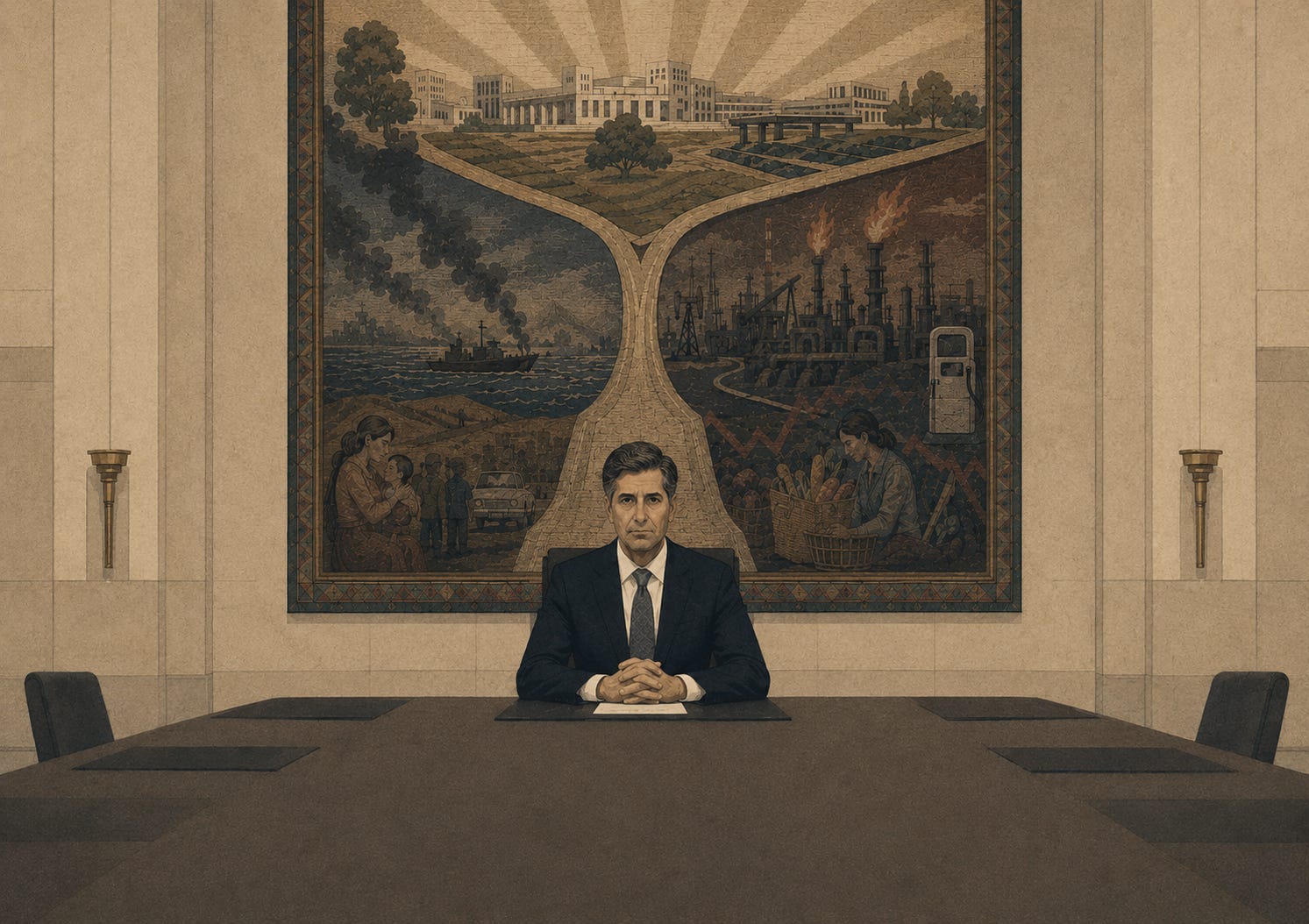
Kevin Warsh has spent 20 years preparing for today. President George W. Bush appointed him to the Federal Reserve Board of Governors in 2006, at age 35 the youngest member in its history. He sat in the room with Ben Bernanke through the 2008 financial crisis, criticized the second round of quantitative easing and left the board in 2011. The next 15 years he spent arguing in lectures and op-eds that the institution he served had lost its way and watching the chair he wanted go to Jerome Powell in 2017. Today he takes the chair.
He inherits a labor market that has stalled, an inflation rate at a three-year high, a widening gap between rich and poor Americans, and the most divided Federal Reserve in three decades. The Senate confirmation that delivered him to the chair, 54 to 45, was the closest in modern history. The interest rates he will preside over set what every American pays for a mortgage, a credit card and a car loan. At his April 21 confirmation hearing, asked by Sen. Raphael Warnock whether the Fed bore any responsibility for the divergence between Americans with financial assets and those without, Warsh answered: “I think the Fed is not blameless.”
But the chair he is about to occupy gives him no room to act on the admission. He has no monetary policy available to him that does not concentrate adjustment costs on the lower third of the United States income distribution — not if he cuts rates, not if he holds, not if he hikes. The war driving the inflation will be over before the consequences of how the Fed handles it are.
Two Americas at the Pump
A paper published last week by the Federal Reserve Bank of New York, which monitors household spending across income brackets, makes the distributional consequences of the Iran war legible in a single chart. Households earning less than $40,000 bought roughly 7% less gasoline in real terms in March, the first month of the price shock. Households earning more than $125,000 bought 1% less. The lower third of American earners spent more and got less; the upper third spent more and got essentially the same amount.
This is the pattern the New York Fed authors describe, in their own term, as “K-shaped”: two lines on the same chart, one rising, one falling. The shape itself isn’t new. It has been bandied about liberally in media coverage over the past few months. The Fed’s own companion paper, also published last week, finds the divergence first appeared in late 2023, has persisted in nearly every quarter since and cannot be fully explained by wage growth. The war is stress-testing a K-shape that was already in place.
A second mechanism pushes the shock further down the income ladder. The political argument for the United States as the world’s largest oil exporter has always been that domestic refining and export capacity would insulate American consumers from global price shocks. The data assembled weekly by JP Morgan’s Michael Cembalest show the opposite: in the United States, wholesale gasoline prices have risen this year by 34% more than international gasoline prices. Naphtha, the petrochemical feedstock embedded in plastic packaging, paint and pharmaceuticals, has risen by 81% more. An Indianapolis commuter has seen the price of gasoline refined in Texas rise faster than a Rotterdam motorist has seen the price of gasoline refined from the same crude.
Energy independence, far from being the firewall its advocates promised, has become the channel through which the war’s costs flow downward.
The Fed’s Quiet Underwriting
The most consequential institutional feature of the Powell era was a posture rather than a policy framework. Criticized at the time for moving slower than inflation hawks wanted, Jerome Powell’s Fed kept rates lower for longer than the consensus prescription would have allowed, and was, whatever its stated rationale, underwriting the labor market for the lower third. Employers ran out of better options. The jobs went to workers they would have passed over in a looser market: people with thinner resumes, less formal education, longer gaps between jobs.
Wages at the bottom of the distribution rose faster than wages at the top in 2022 and 2023, the most significant such compression documented in four decades. The mechanism the Fed used was patience, not redistribution.
That patience is no longer in evidence. The Bureau of Labor Statistics’ April employment report showed payrolls growing by 115,000, well below the pace of the prior two years. February has since been revised to a loss of 156,000, and labor force participation sits at its lowest level since October 2021. At the Fed’s last meeting under Powell, four members of the rate-setting committee dissented — the first such occurrence since October 1992. The labor-market cushion beneath the lower third is being withdrawn at the same moment the energy shock is concentrating costs on it.
No Good Move
Warsh has three practical choices at his June meeting: cut, hold or hike. None breaks the asymmetry.
If he cuts, he is choosing to tolerate inflation, a posture he’s spent the better part of a year arguing against. The lower third pays directly: through groceries, where higher diesel costs work through the supply chain over roughly six months, and through gasoline, which works through immediately. The upper third spends a smaller share of income on both.
If he holds, the labor market is already softening, so holding leaves the burden of adjustment on hiring, which falls first on the workers who got jobs only because the market was tight: the same workers cutting real gasoline consumption right now.
If he hikes, this is the same answer as holding, but the impact on the more vulnerable workers comes faster. Warsh has criticized the Powell Fed for being slow to raise rates in 2021 and 2022, calling that delay a “fatal policy error,” and has called for “regime change in the conduct of policy.”
His record makes the cutting option more rhetorical than real, leaving hold and hike, both of which run through the labor market. Warsh’s own diagnosis of the K-shape, advanced in his confirmation hearing, focuses on the Fed’s balance sheet rather than that channel. His prescription leaves the labor channel exposed.
The Standard Response, and Why it Fails
The case for inaction has weight. When inflation comes from oil, monetary policy is a blunt instrument — the Fed can’t drill wells, reopen shipping lanes or refine gasoline. Raising rates into a supply shock can turn a price squeeze into job loss. At most points in the past decade, looking through the shock would have been the correct call.
It fails now for two reasons. First, looking through inflation means the lower third keeps paying it, in the form of higher grocery and gasoline bills, while the Fed waits. Headline inflation may be transitory but its distributional consequences are not. Second, the demand side is no longer robust: the labor market that the look-through prescription assumes, one tight enough that the cost of waiting is acceptable, no longer exists. The labor-market case would ordinarily argue for support; for the Fed that Warsh inherits, that support is off the table.
Thomas Wright and Arash Azizi, both writing recently in The Atlantic, have made the case that a settlement with Iran remains possible within months. If they are correct, the price shock recedes, but the K-shape doesn’t, and neither does the Fed’s transition. If the war ends, the case for engaging the policy choice on its merits becomes harder to defer, not weaker.
Warsh’s first meeting as chair is on June 16. By then the data on grocery prices, on labor force participation and on consumption by the lower third will have begun to register the war’s effects in earnest. It is the Fed handover, not the war, that will set the terms. The war may pass from the headlines within months. Whether the costs fade as quickly will be decided by the man taking the chair tomorrow, and not by the one who left it.