

No Country for Small Shareholders
SpaceX’s listing is the first to land where three uncoordinated shifts — in Texas law, private capital and indexing — all tilt one way.

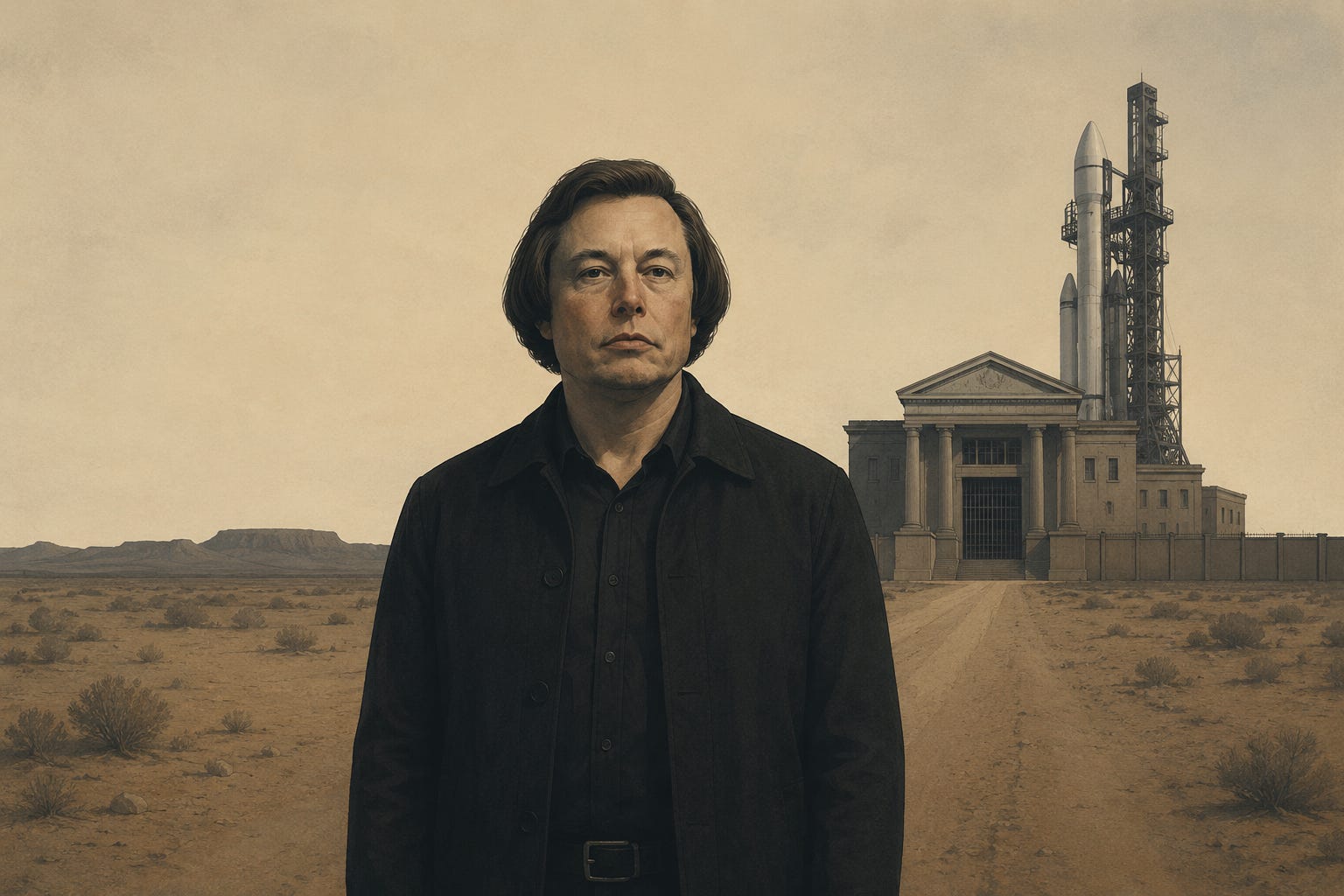
Next month, millions of Americans will become SpaceX shareholders without ever choosing SpaceX. They will buy the stock not because they read the prospectus or believed the $1.75 trillion valuation, but because an index rule requires it. The listing will likely be the largest in recorded history.
The size and the controversy over its valuation, though, are not the only factors that make it unprecedented. For the first time, a single security will arrive in millions of default retirement accounts after three institutional layers have each been rebuilt, in their own domains, to favor the company’s controllers over the public about to own it: state corporate law, the rules governing private capital and the rules governing passive savings. Built separately and for unrelated reasons, the three nonetheless lean the same way, and SpaceX is the first company where all of them apply to a single security.
The Exit
For most of a century, Delaware has been the legal home of corporate America, its Court of Chancery the nearest thing the market has to a supreme court for disputes over ownership. For the past two years Texas has been building a rival to take that business away. It passed Senate Bill 29, a sweeping rewrite of its corporate code, in 2025, opened a dedicated business court the year before, and won approval for a new stock exchange backed by BlackRock, Citadel Securities, Charles Schwab and Goldman Sachs. The state did not merely lure companies from Delaware; it gave them an entire alternative, a code, a courthouse and a market of their own.
Under the new code, the main tool shareholders have for holding a board accountable can be priced out of existence. A derivative suit, brought on behalf of the company itself when its leaders breach their duties, can be restricted to plaintiffs owning at least 3% of the stock. At SpaceX’s expected $1.75 trillion valuation, that is a $52.5 billion stake. Because the public float will be only about 5% of total shares outstanding, the 3% bar exceeds half of everything the public can trade.
Outside Elon Musk himself, who holds roughly 41% of the company, no shareholder can clear it, and even the three largest passive managers combined fall well short. The recourse exists on paper, but the math makes it unreachable.
The 3% bar is only the most expensive lock. Class actions can be banned outright by bylaw. Disputes under federal securities law can be funneled into a single Texas court, with a jury-trial waiver, meaning a judge rather than a jury decides, and a fallback to private arbitration. Buying the stock counts as consent to all of it.
None of this is theoretical. In March 2026, a federal court in Texas threw out a derivative suit from a Southwest Airlines shareholder who held 100 shares and objected to the end of the airline’s free checked-bag policy. The plaintiff could not meet Southwest’s 3% threshold under SB 29, so the court never reached the merits. SpaceX is building on a precedent that already works.
Tesla ran the play first. When it asked shareholders to approve its move from Delaware to Texas in June 2024, its special committee assured them it had found “no areas in which Texas and Delaware law meaningfully diverged” on matters of substance. Eleven months later, with SB 29 in force, Tesla adopted the 3% threshold at its first bylaw revision. The heads of three of the largest U.S. public pension funds, Marcie Frost of CalPERS, Tom DiNapoli of New York State and Mark Levine of New York City, who manage roughly $1 trillion between them, wrote to SpaceX on May 14, 2026, calling the structure “the most management-favorable governance structure ever brought to the U.S. public markets.” On April 13, 2026, the Delaware Court of Chancery upheld Tesla’s Texas-forum clause, a signal that Delaware will not fight to keep the companies fleeing it.
The Capture
A board’s protection from lawsuits matters most after the IPO, once the early investors have sold and only the public is left to object. The same lateness defines what the public is buying. Over the past 13 years the rules for raising money privately have been rebuilt so that a company does most of its growing before it ever lists, and the gains go to those who were let in early.
In 2020, the hedge fund D1 Capital bought into SpaceX at a valuation of around $36 billion. Its stake is now worth roughly $20 billion, and the firm’s founder, Dan Sundheim, has shown no inclination to sell despite heavy interest from would-be buyers. His patience has a public cost: at the targeted $1.75 trillion, about 98% of SpaceX’s rise will have happened before any public investor could place a bid. The other winners are private, their holdings listed in the prospectus and worth, at the offering price, about $15 billion for Darsana Capital, $70 billion or more for Antonio Gracias’s Valor Equity Partners, $5 billion for Founders Fund’s Luke Nosek and more than $1 billion for each of a row of executives.
All of it was built in the open. The JOBS Act of 2012 raised the threshold at which companies must report publicly from 500 to 2,000 holders, and lifted the ban on openly soliciting private investors. The definition of an accredited investor, the legal category of wealthier individuals allowed into private rounds, hasn’t been adjusted for inflation since 1983. Marketplaces such as Forge and EquityZen now let private shares change hands among the accredited, gated by the company’s right of first refusal. What results is a market that is deep, liquid and entirely closed to the public.
Whether companies are simply staying private longer is partly contested. Vanguard has argued that much of the decline in public-company counts is a microcap story. The narrower claim survives that critique: by one estimate, the share of value creation occurring in public markets has fallen from roughly 88% historically to closer to 45% for IPOs in the past five years. SpaceX is the vivid case, not the average one.
Retail investors who want a piece have to pay for the privilege. The Destiny Tech100 fund, a closed-end vehicle with about 16% of its portfolio in SpaceX, traded this spring at more than double the value of what it actually holds, roughly $60 for $25 of assets. The funds and venture firms hold the cheap private shares. The public holds expensive paper claims on them. The asymmetry isn’t a bug but the system performing exactly as built.
The Handoff
The last step is the one that reaches ordinary savers, because the same logic now runs through the indexes inside most retirement accounts. The Nasdaq-100, tracked by more than $600 billion, used to require a 6-month wait before a newly listed company could enter, until the exchange consulted its licensees and cut that to as little as 15 trading days. Unlike most indexes, it doesn’t weight companies by the shares actually available to trade. Instead it applies a multiplier: a company floating just 5% of its stock enters as though it had floated 15%, and the weight ratchets up as lockups expire and more shares come loose.
FTSE Russell has moved to a similar 5-day rule. The S&P 500 is reportedly weighing its own version of accelerated entry, including dropping its longstanding requirement that a company trade publicly for 12 months and post a year of profit.
A fund that tracks the Nasdaq-100 isn’t supposed to bet on any one company, yet when SpaceX joins, every such fund will have to buy it. Dave Nadig of etf.com estimates that means roughly $7 billion of buying in a single day, on a date set well in advance, which lets other traders buy first and push the price up. In studies of these rushed additions, the funds typically end up buying near the top. The saver who chose an index fund precisely to avoid picking stocks ends up holding SpaceX anyway, bought high and never chosen. As Nadig puts it, “private investors capture the compounding; public investors inherit the operating concern.”
Here the three layers meet: what the private market captured gets delivered, by index rule, to the public that Texas has stripped of recourse. “It will be impossible to not own them,” one adviser on the deal told the Financial Times. The largest passive managers, BlackRock, Vanguard and State Street, will be the biggest buyers, not because they judged SpaceX worth owning but because their index funds must hold it. The legal scholars Lucian Bebchuk and Kobi Kastiel call the structure a “small-minority controller” regime, one in which control persists even as the economic stake declines.
The saver who never chose SpaceX will still get the share. What they will not get is what the public share once carried: a court that would hear them, now closed in Texas; a company whose growth they could share in, now finished in private before they can buy; a price set in the open, now a forced trade scheduled in advance. SpaceX is the test of whether public ownership still means ownership rather than mere exposure, and whether anyone with the standing to ask is still in the room.